Showing posts with label Don Messick. Show all posts

Monday, September 14, 2026

My Favorite Don Messick Roles

 I'm not quite done with talking about Don Messick just yet. Consider this post a fun bonus if you will. Back in 2024, I put together a list of my top five favorite Daws Butler roles. Now, I'm doing the same for his frequent co-star. These are, in no particular order, my favorite voices Don Messick did for Hanna-Barbera. As I'm only including five, there's going to be more than a few great characters that won't make the list. I implore you to share some of your personal favorites in the comments below, no matter how well known or obscure they may be. Now, with that out of the way, let's get into the list.

Scooby-Doo


This one is a no-brainer. If you've been following this blog for long enough, you probably know I'm not the biggest Scooby-Doo guy these days, but it would feel almost criminal to not include him on this list. He's easily the most popular of the characters Don voiced, and for good reason. While he may be cowardly, when push comes to shove, he'll do what is right and stand up for his friends. As Don himself often pointed out, "He's got human foibles. He gets into problems, but he always lands on his feet."


Astro


Moving on from Scooby, we have his predecessor, Astro, who I honestly like more than ol' Scoob. His relationship with the Jetsons family is great stuff, particularly those with Elroy and George, which couldn't be more different from each other. Despite being very similar to Scooby, Astro does have plenty of qualities unique to him, one of those being Don Messick's performance. Like the character himself, Don's performance is more over the top and exaggerated, unlike Scooby-Doo, who is more cautious and unsure. You've also gotta hand it to Astro for being the only Jetsons character to have a spin-off series, for whatever that's worth.


Boo Boo


I ranked him as one of my favorite HB characters, so of course Boo Boo had to show up here as well. Boo Boo is the perfect accomplice to Yogi, and likewise, Messick's performance is perfect alongside Daws Butler as Yogi. Whereas Yogi's voice is big and over the top, Boo Boo is more quiet and cautious. He's very much the straight man in the duo, and though another actor could have made that quite boring, in the hands of Don Messick, he's anything but. It's hard not to think of his voice when seeing the character, and in my book, that's the mark of an extraordinary voice actor.


Benton Quest


While Don Messick wasn't the actor who originated the part of Dr. Benton Quest (that honor goes to the great John Stephenson), he's without a doubt the man who made him one of the more memorable fathers in animation history. While the voice of Benton isn't too different from Don's normal voice, there's a lot more to voiceover work than doing crazy voices. Messick brought Dr. Quest both a warmness and intelligence that was vital to the character. Beyond that, the fact that the show was an action-adventure series gave Messick the opportunity for some more serious character work, which is also appreciated. Besides, who wouldn't want their dad to be a genius that takes them all over the world?


Muttley


Last but not least, I've got to give props to Dick Dastardly's nasty accomplice, Muttley. Though he's another canine character like Astro and Scooby, he might be the most unique fellow out of all of these guys. He doesn't have the character of someone like Dr. Quest or Scooby, nor does he have much of a vocabulary. Despite all that, Messick makes the character memorable with one of the most recognizable laughs in animation history. While Muttley wasn't the only character Messick played to have that distinct laugh, it's hard not to think of him when you hear it. How many other characters can you think of that are remembered from just a simple laugh? The character was a terrific sidekick to the also memorable Dick Dastardly, and their hijinks were definitely a high point of Wacky Races. Muttley is proof that a great actor can make even the simplest of roles ones worth remembering, and I think that's one of the great things about Don Messick. Just like Daws Butler and Mel Blanc, he created so many characters that endure to this day. No matter where you go, people know not just who Scooby-Doo is, but what he sounds like. If that's not an impressive legacy, I don't know what is.

Friday, September 11, 2026

Video of the Week: A Don Messick Demonstration

 To close out this week long celebration of Don Messick, I've got quite the video for you all to check out. This comes from the late Paul Maher's great archives, and showcases Don at what I believe is a charity event from the late 1980s. It's a pretty long video, and throughout Messick discusses everything from his early work to The Duck Factory. He also demonstrates many of his voices, including the New Zealand kiwi bird that was mentioned in Monday's post. Give it a look down below!


Thursday, September 10, 2026

Don Messick Tributes

 On October 24th, 1997, Don Messick passed away at the age of 71 following a stroke. His passing was a huge blow to the animation world, and an outpouring of support from the community soon followed. Today, I'm sharing several of the great tributes that were put out in honor of the one and only Don Messick.

Here's a tribute from the year 2000 by Brett Rogers, a freelance writer who often wrote for Animation World Magazine. It also features some fantastic quotes from Messick, originally sourced from an interview Rogers conducted with him back in 1995. 

Scott Innes, who took over the role of Scooby-Doo following Messick's retirement and knew him in his later years, wrote this poem in honor of the vocal giant.


Hanna-Barbera themselves put out this touching piece in Don's memory, featuring Shaggy and Scooby-Doo in mourning. The artwork was drawn by Iwao Takamoto, a Hanna-Barbera mainstay and character designer for the Scooby-Doo cast.


Lastly, Mark Evanier, a man who has written many a comic book and cartoon, put together this extremely well written piece on Messick shortly after his passing. Though Don Messick passed away almost thirty years ago, his legacy will no doubt endure for years to come, and not simply because of his characters. It is the memories and the ways he impacted the lives of so many that I personally think will be his greatest legacy of all.

Wednesday, September 9, 2026

Messick Enters The Duck Factory

 Don Messick could be found in cartoons, radio, and commercials, but in his career that spanned over fifty years, Messick only had one major on-camera role. That, my friends, was The Duck Factory.

Never heard of it? That's for good reason. It was a sitcom that aired on NBC for only three months in 1984. It follows the employees of the titular Duck Factory, an animation studio behind the popular in-universe animated series, "The Dippy Duck Show." Messick plays, rather fittingly, a voice actor known as Wally Wooster, allowing Messick to show his vocal talents even in a live-action setting. 


The show in general had quite an impressive ensemble cast. Jay Tarses, a writer for The Bob Newhart Show, portrays a writer at the studio. Jack Gilford and Clarence Gilyard Jr. both play artists, while Teresa Ganzel, another HB voice actor, is Sheree Winkler, who runs the company. And for the lead role of cartoonist Skip Tarkenton, we have some guy named Jim Carrey. Never heard of him before. 


While this all sounds fun and it definitely has the makings of a sitcom classic, the show itself is just kind of fine. It's nothing horrible for sure, but it's also not that great, either. But if you'd like to judge the show yourself, check out the first episode below. The other twelve are also available online, as the show has unfortunately never been released in full on home video. It's certainly not the best show, but it's great to see Messick perform a role for once rather than simply hear him. 


Tuesday, September 8, 2026

Don Messick Commercials

 As yesterday's post pointed out, in addition to his work in cartoons and radio, Don Messick was also often heard in many commercials throughout the years. Today, I'm going to share three of them, all from different eras of Don's career.

Starting off, here's Don (sounding a lot like Droopy) being heard in an international highway signs public service announcement from the 1960s. However, he's not alone here. Tell me if the other voice in this clip sounds familiar?


Jumping forward to 1981, we can hear Messick in this Green Giant commercial, voicing Mr. Owl (no, not that one). No longer informing viewers about traffic safety, Messick instead tells them about the wonders of Green Giant Niblets Corn.


Finally, you can't really talk about Don Messick without talking about Scooby-Doo, and over the years, Messick voiced the character in plenty of commercials. This one aired on Cartoon Network in 1994, and as you can guess, is a commercial promoting the show airing on the channel. Once again, Messick is joined by one of his frequent animation costars. This time, it's Casey Kasem as Shaggy. Definitely a short promo, but a sweet one all the same.


Monday, September 7, 2026

Don Messick at 100

Yes, you read that right. It was on this day 100 years ago that one of the voice acting greats, Don Messick, was born in Buffalo, New York. There's a lot one can say about Mr. Messick. You can discuss his characters, his love of ventriloquism, his charity work, the list goes on. This week, you're getting five straight posts of nothing but Don Messick. Today, we're starting with this surprisingly in-depth profile on Messick from the Santa Barbara News, published on January 24th, 1987. Messick reflects on his career, bumping into Bela Lugosi, and a favorite character of his you've probably never heard of.

I think that's enough out of me, though. Enjoy this deep dive into one of the best to ever do it, and then some! 


A man of a thousand voices

By Joan Crowder

    You might not recognize the face, but you've certainly heard his voice. He's been a flea, a talking spoon, a lemon, even a Rice Krispie. He's Scooby Doo, Bam Bam, Boo Boo Bear, Ranger Smith, Muttley the dog, Astro, and Papa Smurf.
    If you're more inclined toward the classical, you've heard Don Messick's voice on the local classical music radio station KDB (1490 AM, 93.7 FM).
    "When my voice started to change at about 13, I discovered it had an amazing flexibility," Messick said in an interview at his home and studio. "My parents gave me my first ventriloquist's dummy, and I bought a book and practiced in front of a mirror. I sent away for my second dummy, Woody de Forest," Messick said, introducing Woody who sat on the window seat in Messick's living room, along with Scooby Doo and a menagerie of stuffed animals and puppets.
    As he introduced these friends, each in its own voice, he explained that each one is dear to him, reminding him of various phases of his career. Woody donned a uniform and went in the service with Messick when he was drafted at 18. The little kiwi bird hand puppet recently toured children's hospitals in New Zealand with Messick, and Scooby, well, "'Scooby Doo' was the longest running network cartoon, running for 16 years before going into syndication."
    "The Smurfs" cartoon is in its seventh year, and Messick says he likes being Papa Smurf "because he has a good image." He gets fan letters for Papa Smurf. One girl wrote about a problem she had and said she wanted to know what advice Papa Smurf could give her. 


    Messick said radio and television are not as impersonal as one might think. He once got a braille fan letter for Scooby Doo and has kept up the correspondence with the blind girl from Pennsylvania who sent it. She and Messick correspond with cassettes.
    "It's nice to realize that you can have a one-to-one relationship through the immediacy of TV," Messick said.
    Messick had his first radio program at age 15, a 15-minute sitcom patterned after his favorite radio programs of the time, Jack Benny, Fibber McGee, Burns and Allen. He did all the voices himself—live.
    When he was drafted, during WWII, he met many people in broadcasting who later helped him break into the business. He worked in special services as an entertainer toward the end of his time in the service. When he got out, he became a free-lance radio actor on such shows as "Let George Do It" and "Night Beat."
    He had attended acting school in his home town of Baltimore and appeared on various radio shows. "I played a lot of doctors," Messick said. "I guess I had a good doctor voice."
    After the army, Messick went to New York for what he calls his "starving era." He appeared on the "Ted Mack Show" under various names. He said they sprinkled the amateur show with some quality so it wouldn't be too bad.
    It was during this time that he appeared as a ghost in a midnight spook show with Bela Lugosi. "Lugosi and his wife had a suite at a big hotel, and I didn't have any place to stay, so they invited me to share their suite."
    Messick and Woody did their ventriloquist act regularly on the "Horace Heidt Show" on television and they went on the road with the Dick Contino Company.
    When Messick came to Los Angeles in the 50s, he worked for six years on the "Beanie and Cecil" puppet show, doing a grueling three shows a day, five days a week.
    He got his start in cartoons at MGM, when he substituted for the regular voice of Droopy the Dog, Messick said, in Droopy's voice.
    "At the time they were releasing backlogs of cartoons because animation as they were doing it then, like Disney and the old Tom and Jerry cartoons, was too expensive for TV."
    Bill Hanna and Joe Barbera were the pioneers of limited animation, and Huckleberry Hound, Yogi Bear, and Scooby Doo came out of that movement. 
    "We do the voices first, then they animate to the voices," Messick explained. "With the voice-overs you do your job and get out fast."


    Residual fees for doing the cartoon voices have changed over the years, Messick said. Originally, under the Screen Actors Guild, after a cartoon's sixth run, the actors got no more fees. This was revised in the mid-60s to eight, then 10 runs. Now the residuals continue ad infinitum, but drop off after the 10th run.
    Payment varies for a commercial. If it is shown during a program, such as a commercial that interrupts a movie, payment is higher than if it is a "wild spot," which is shown between programs.
    A new two-hour Hanna-Barbera special, "The Jetsons Meet the Flintstones" are being filmed currently and Messick goes to Los Angeles to work on those. He is Astro, the family dog.
    He is also the voice of the lemon for Lemon Joy and Snap, of Snap, Crackle and Pop cereal fame. He's been a flea, a mosquito, and a hornet on the Raid commercials. He regularly auditions for cartoons and commercials through his agent, Charles Stern, in Los Angeles.
    He said when he first got the job as Joy lemon, he was flown to New York to "sit in the studio for hours" while they got the animation ready for his voice. He said he liked the trips to New York, but the method was too time consuming. Now they send him a video of the animation and he dubs the voice.
    Messick has come out from behind the screen in recent years to do live performances for children in hospitals all over the country and in England and New Zealand. He got started on this project through Kentucky Fried Chicken's support campaign for the March of Dimes. He was asked to travel to major cities to appear on talk shows and interviews to explain the work of the charity. He was asked to do a similar thing for the Spastic Children's Society in England and for the Crippled Children's Group in New Zealand.
    While he was shopping in New Zealand, Messick saw a kiwi bird hand puppet, and decided to adopt it for his appearances with the children in the hospitals there. He gave the little bird a New Zealand accent and it was a big hit. Now it's one of his favorite characters. He demonstrated the little fellow's accent in a conversation with Scooby Doo. The two voices interacted swiftly as Messick switched from the New Zealand accent to the Scooby voice.
    In addition to the satisfaction he gets from entertaining, Messick said the tours have given him insight into how much can be done through technology for the handicapped now. "I have gotten acquainted with some of these people who could do nothing. Now they are able to activate machinery which enables them to communicate and do things."
    The touring has an added advantage for Messick. "It gives me a chance to get into radio facilities of all kinds," he said. "In England radio stations are often in beautiful old manor houses, and I got to visit the BBC in London."
    Messick said he enjoys announcing for the KDB classical musical station here. He tapes the programs in his Sundial Studio, and he said he learns a lot about classical music and composers by doing it.
    The studio, an eight-track facility, is also used by local advertising organizations to tape commercials, sound effects and production music.
    Messick said he spends a good deal of time in the studio. "Radio is still my first love," he said with a smile.

Friday, September 5, 2025

It's Really Don

 Tomorrow marks 99 years since voice-acting titan Don Messick was born. My favorite voice actor of the Hanna-Barbera family, I had to have something here to mark the occasion, and I think I came across quite a find.

Below is a piece on Messick that ran in the February 1st, 1972 edition of the Santa Barbara News Press. The focus is primarily on Messick's animation work, but there are also some great details about his early forays into acting here, too. It's a short but sweet piece, and even comes with a nice illustration of Messick, shown alongside those he brought to life. And for what it's worth, this is probably the only time you'll see him discuss the character of Schleprock from The Pebbles and Bamm-Bamm Show.


Pixie or Boo Boo...It's Really Don

By Mary Every

    Firing off his vast repertoire of voices, Don Messick catapults a listener back to bed on that Saturday morning when...
    The TV last heard in the depths of the night was in the middle of a late, late show.
    Then, suddenly in bright morn, it is emitting the yips and yaps of animated little creatures.
    And the first impulse of the awakened adult is to turn the damned thing off.
   

 Forget it, though, if there are little ones wrapped up in that television make-believe world. And don't spoil their fun by telling them that Flippopotamus and Schleprock are really a man named Don Messick who lives right here in Santa Barbara.
    The two cartoon characters are among the latest roles for Messick, a voice-over artist who commutes to auditions and work in Los Angeles from his home at 63 Humphrey Rd. They are viewed simultaneously on different networks at 10 A.M. Saturday in the "Curiosity Shop" and "Pebbles and Bamm Bamm" shows.
    Flippopotamus, as described by Messick with appropriate inflection, is a "swingin, real cool hippo" and Schleprock, again with appropriate inflection, "is a teenager, but kind of a bad luck omen, walks around with a black cloud over his head."
    The "Pebbles and Bamm Bamm" series, noted Messick, is an outgrowth of the "Flintstones" series, the first and longest-running cartoon show on TV prime time.
    
Among Messick's favorite characters have been Boo Boo on "Yogi Bear," Muttley, the snickering hound on "Dick Dastardly," and Dr. Benton Quest on "Jonny Quest."
    Other versions of his voice have been attached to Ranger Smith, Scooby-Doo, Ruff and Professor Gismo in "Ruff 'N' Reddy," Pixie Mouse on "Huckleberry Hound," a little monkey called So So, and a dog with a bit of an Irish accent on "Dr. Doolittle."
    Recently, Messick did some voice work on a feature-length animated film, "Charlotte's Web," to be released in April. The film features the voices of well-known film stars, such as Debbie Reynolds, who does Charlotte. Messick does Jeffrey, a little gosling.
    Something many people don't realize, said Messick, is that in film cartoons, "the voice track is done first, and then the cartoons are animated. The animators draw characters according to the voice. We are shown a storyboard of the episode, a sort of roughed-out comic strip of the main action and attitudes of the characters."
   
 About his rather unique profession, he noted that "compared to other types of performers, it is a rather restricted field." He has also done commercials for television and some radio spots.
    "I may be called at any time for an interview regarding commercials or a new cartoon series, and am required to be in Los Angeles at a moment's notice," said Messick. "In fact, I have driven to LA for interviews twice in one day."
    He explained his work as applying human characteristics and voices to animals, noting that "I don't do impersonations—period. I like to think of myself as a vocal quick-change artist."
    Most of his cartoon series work has been for Hanna-Barbera productions, and it started with three different voices in "Ruff 'N' Reddy" in 1958. 
    Messick fell into his field in both a natural and flukish sort of way.


 "I was always interested in acting," he said. "When my voice changed when I was about 12 1/2, I discovered I had two voices. So I became a ventriloquist.
    "My parents got me an inexpensive ventriloquist dummy when I was about 13. I practiced in front of a mirror, learning to talk without moving my lips."
    At the age of 13, Messick began making local appearances as a ventriloquist in the rural area of Maryland's Eastern shore, where he lived, and at 14, he had his own weekly radio program.
    When he was 16, he went to Baltimore to study dramatics and became involved with legitimate theater.
    After several years of doing Off-Broadway parts in New York and Hollywood, Messick became the voice behind a lot of puppets on television shows.
    
The live puppet shows, which were presented to the television networks in a production package, became "impractical" for the stations when the major motion picture studios started releasing their backlogs of theatrical cartoons for television, Messick said.
    After a few years, he continued, "the public was satiated with old cartoons." And the major movie studios, for economic reasons, had discontinued cartoon production.
    Hanna-Barbera Productions was formed to supply cartoons for TV use, and Messick had been working for them from the beginning.
  
  "In the past 15 years," he noted, "I have done over 50 cartoon series. Many are still running.
    Messick has his own production room at his home here. It's a hobby room, where Messick's 16-year-old son, Tim, a photography buff, has a corner for his darkroom equipment. Messick uses his recording equipment in the room to develop new voices, produce demonstration tapes of past voices, and dub music.
    "I'm especially interested in Japanese music," he commented. The modern especially fascinates me—the combination of the traditional oriental sound blended with the new Western influence."

Tuesday, May 6, 2025

Daws and Don Congrat Bill and Joe

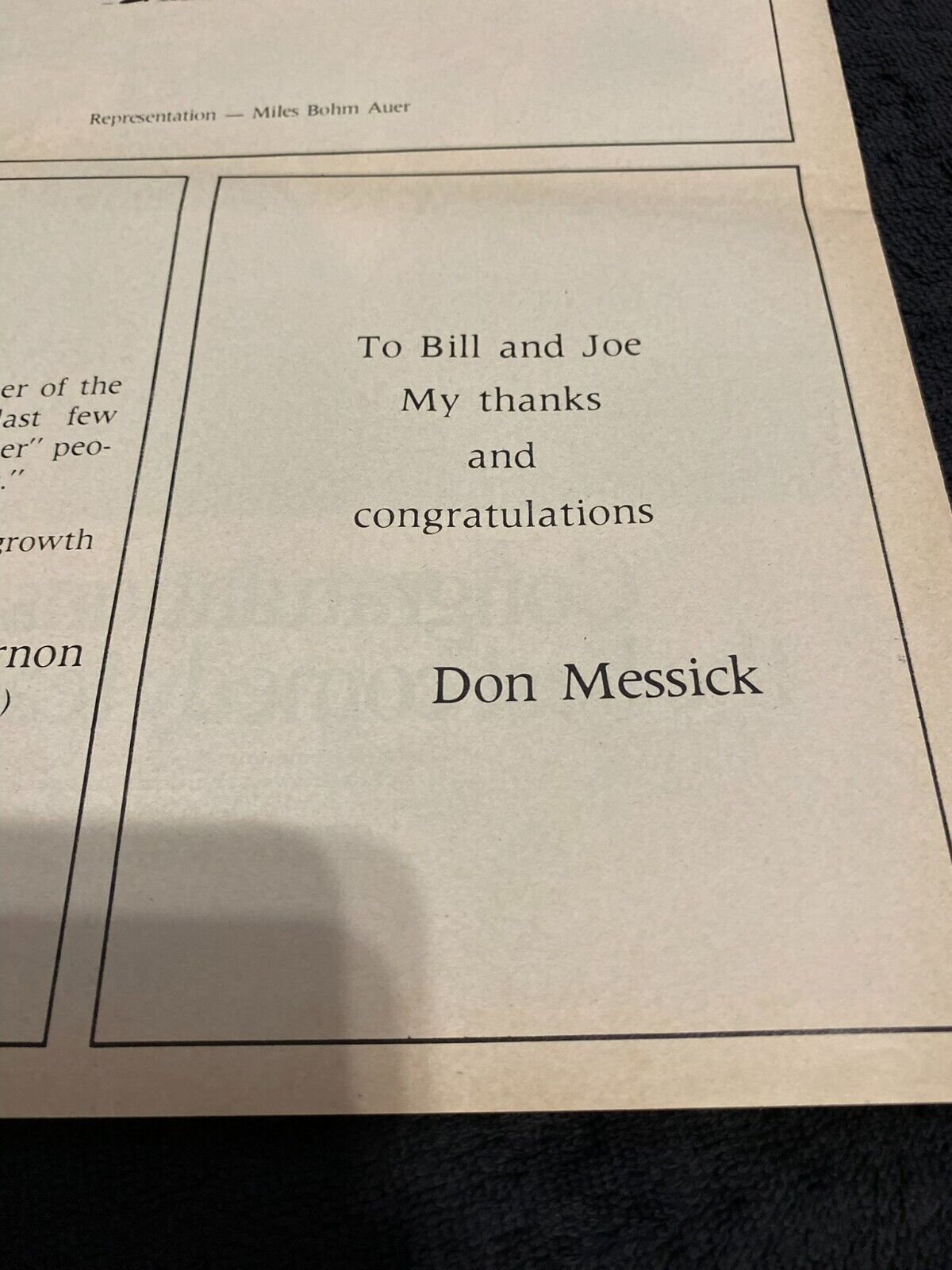
 I've got a neat find for today's blog post. Below is a 1977 print ad that appeared in several entertainment trades (this copy in particular came from Variety). It congratulates Bill Hanna and Joe Barbera for Hanna-Barbera's twentieth anniversary, calling them "one of the best comedy teams of all time."


Taft weren't the only ones congratulating the duo. Another Hanna-Barbera duo, Daws Butler and Don Messick, also had ads celebrating the occasion. Daws' even features a caricature of himself, as was standard in his business cards and other similar items.


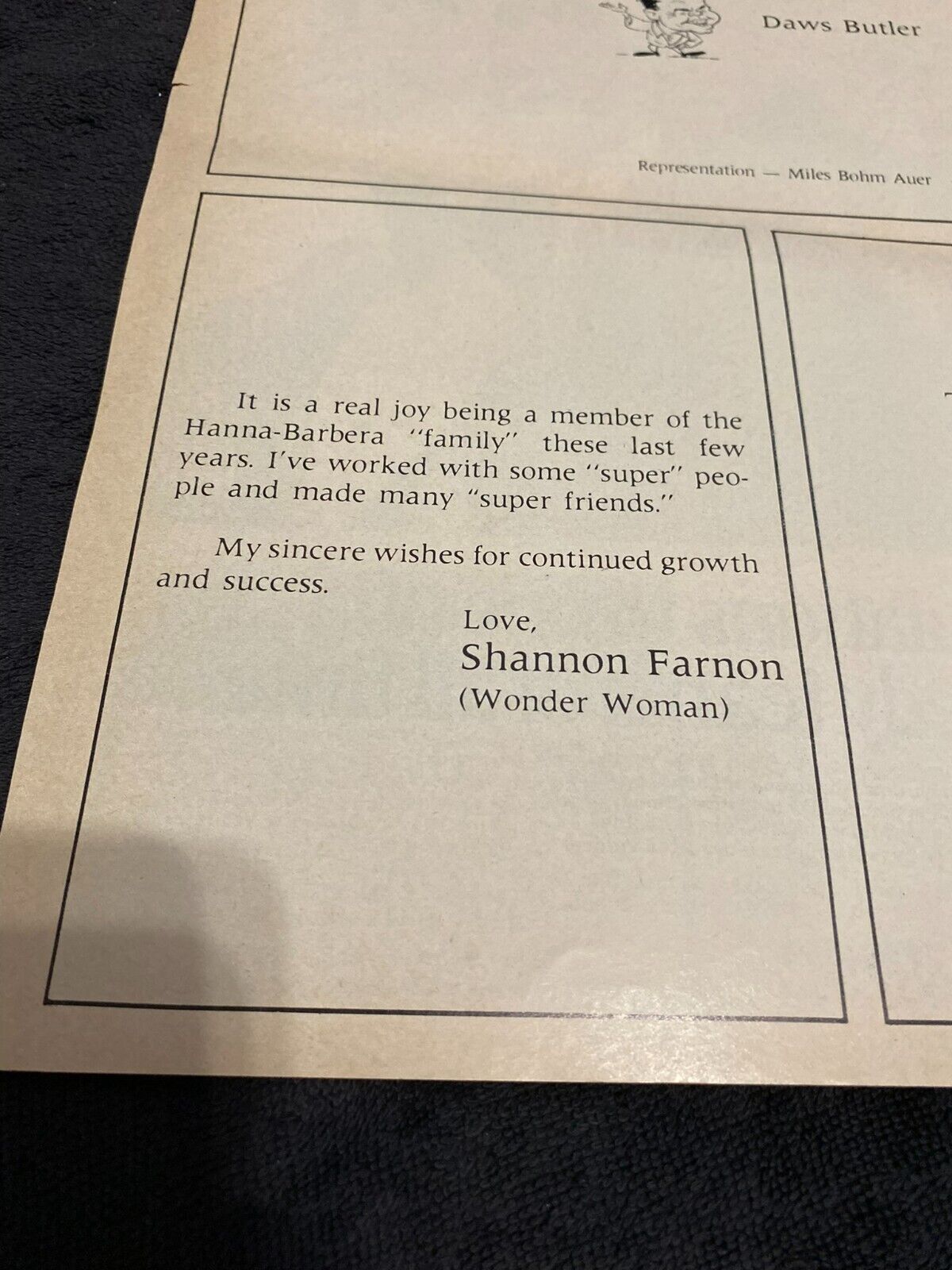
As a bonus, here's another congratulations, this time from Wonder Woman herself, Shannon Farnon. Apart from Superfriends, Farnon was also heard on Hanna-Barbera's Valley of the Dinosaurs. 


Wednesday, January 8, 2025

Don Messick: The Live Performance

 As I mentioned in last week's "Top Ten Hanna-Barbera Voice Actors" list, Don Messick is my personal favorite of the actors I included. So why not follow that up with a look at one of Messick's most obscure performances? This was something I learned of a while ago, and have been meaning to share it here. In early 1996, Don Messick participated in a live take on the classic Peter and the Wolf musical. Given this was the same year Messick retired from the industry, this may very well be one of his last voice-over performances, as well as one of his final public appearances. The January 5th edition of the Lompoc Record promoted the event, which you can read below. 

Interestingly enough, this was not the only time Messick was involved in a take on this particular musical. It was also done in 1993, which you can read about in this post from Yowp's blog. Also interesting is that they specifically mention it as a one-time performance. Clearly, that didn't exactly stick. 

Peter and the Wolf multimedia concert on stage at Lobero

    SANTA BARBARA—It's a day for the young and young-at-heart Sunday as the West Coast Symphony, under the direction of Christopher Story, presents a lively multi-media staging of Sergei Prokofiev's classic musical tale, "Peter and the Wolf."    
    The show takes place in the Lobero Theatre, 33 East Canon Perdido, at 3 p.m.
    Prokofiev combined narration with orchestration to vividly tell the exciting story. In the tale, a young Russian boy lives with his grandfather at the edge of a deep, dark forest. The audience hears, through word and instrument, Peter's adventure as he attempts to capture a wolf from the forest and deliver him to a zoo.
    International "voice-over" star Don Messick is the narrator. He has been the voice of many popular Hanna-Barbera cartoon characters since the 1950s. Over the years, Messick has received many awards for his vocal contributions to the animation industry. 


    In "Peter and the Wolf," he enlists his famous cartoon alter-egos, Boo-Boo Bear, Scooby Doo, Papa Smurf, Ranger Smith and others in the narration.
    Cartoon slides by artist Jamie Pfeifer add delightful visuals to the performance. 
    To open the program, storyteller Michael Katz spins one of his fabulous tales, with sound effects by the orchestra.
    He is the storytelling radio show, "Katz Pajamas," on KCBS. He is also the artistic director of the Flying Leap Storytelling Festival held annually in Solvang.
    A master storyteller, Katz finds exciting ways to pull his audiences into the multicultural folktales and personal adventure stories that he tells.
    Clowns from "Clown Town" add to the merriment of the afternoon.
    The program is sponsored by the Lobero and Cielo Foundations. Tickets are $20 general; $15, seniors and students; and $10, children and handicapped persons. To order, call the theater at 963-0761. Visa, American Express, and MasterCard are accepted.

Thursday, October 31, 2024

Hanna-Barbera Voice Actors on TV: Scooby-Doo Edition

 It's been a minute since I did a new entry in my "Hanna-Barbera actors on TV" series, but I'm back, and this time around, I thought I'd get a little festive. Since Halloween is today, and the franchise recently celebrated its 55th anniversary, this installment will be all about a certain group of meddling kids and their dog. You all know by this point that I'm not the biggest Scooby guy, but it felt wrong to have October go by and not do something related to the series. Let's look at the actors behind the original Scooby-Doo, and some of their onscreen TV appearances!

I'll start with Casey Kasem. Between his work in radio and animation, Kasem didn't make a whole lot of appearances in live-action TV roles, but that's not to say they were nonexistent. One of them is from the Hawaii Five-O episode "Steal Now Pay Later." This is probably the angriest Kasem has ever been in a role I've seen. I certainly couldn't see Shaggy getting this upset!


I couldn't find a clip of this particular appearance online, but when it comes to the original Daphne voice actor Indira Stefanianna, there's no live-action role more notable than her appearance in M*A*S*H. She appeared in the episode "Love Story" as Lieutenant O'Brien, and was credited as Indira Danks.


Velma's original voice actor, Nicole Jaffe, never appeared in a live-action TV role (though she did appear in a film with none other than Frank Welker!), so I'll instead look at her second voice, the late Pat Stevens. And just like Stefanianna, her most notable role was in the series M*A*S*H. She played a nurse character in over a dozen episodes between 1974 and 1978.


I've already looked at Scooby himself, Don Messick, in another entry in this series. But what if I told you his only starring role in a live-action series, The Duck Factory, also featured an appearance from Fred Jones himself, Frank Welker? This occurred in the episode "The Duck Stops Here," where Welker plays a voice actor trying to take Messick's most famous character voice after he loses it. Though we don't see them interact in the episode, it's great fun to see the two onscreen doing what they do best. It also feels like a bit of foreshadowing, as Welker would eventually inherit many of Messick's characters after his retirement. 


And that's everything for October, folks! I'll wrap this up by congratulating Scooby-Doo on 55 years, and I hope you all have an especially spooky Halloween!

Thursday, September 12, 2024

Video of the Week: Don Messick at the 50th Golden Awards

You all know I love getting an opportunity to talk about all things Don Messick, and seeing as this past weekend marked what would've been his 98th birthday, now seemed like a fine chance to do so. For this week's video segment, I've got an interview Messick did during the 50th Golden Awards event in 1989, where Messick acted as the master of ceremonies. This interview was conducted by Paul Maher, an individual who interviewed many great names in classic animation, and this was one of several talks he had with Don. Some of the topics covered in this interview are his voices for Hanna-Barbera, his relationship with Daws Butler, and his more recent work in animation. 


Wednesday, July 31, 2024

Don Messick Travels Across the Pond

I've got one last post to finish off July, and I think I may have saved the best for last. Below is an English newspaper article focused on Don Messick. As his son Tim mentioned in my interview with him, Don made a lot of overseas visits in his later years to children's hospitals and similar locations. During such occasions, Messick shared his many character voices, and entertained children with his ventriloquist abilities. I was never fortunate enough to meet Mr. Messick, but stories like these really show that he was just as sweet and kind as many who worked with him over the years say he was. I hope you enjoy this piece, which ran in the Medway News on November 14th, 1986. And before you say anything, yes, the list of characters the paper claims Messick voices is...let's just say "questionable."

Scooby in the Priory

    Handicapped youngsters in Strood were delighted by a visit from their favorite cartoon characters.
    Fifty children at Ravenswood Priory were able to talk to Scooby Doo, Yogi Bear, Boo Boo, Hong Kong Phooey, Papa Smurf, Penelope Pitstop, Dastardly and Muttley. And they are all the product of one man's voice box. 


    Don Messick, who is the voice behind more than 30 cartoons, was starting a two-week tour of Spastics Society day centres around the country with his children's show.
    He ran through his most famous characters and also did a ventriloquist act with his Papa Smurf puppet.
    The children at the day centre for the handicapped were captivated by Don's ability to switch back and forth between characters.
    Don's visit was organized by Medway Area Care Project, which works under the auspices of The Spastics Society. It holds play days every school holiday for children who are mentally or physically handicapped.


Just as Messick enjoyed entertaining children, it looks like the media in England enjoyed interviewing the voice-acting veteran. In 1984, he appeared on the popular British children's program Blue Peter, as evidenced by this blurb below. He'd appear during a segment on ITV News a decade later. I'd share one of these in this post, but unfortunately, it doesn't look like they're available online. If I had a nickel for every Don Messick TV interview I knew of but couldn't find, I'd be rich! Well, not quite, but you get the picture.


Thursday, April 18, 2024

Don Messick's Moment in the Spotlight

 Earlier this month, I had the pleasure to share with you all an interview I conducted with Tim Messick, son of Hanna-Barbera voice actor Don Messick. If you happened to miss it, check it out right here. That interview made me feel like I should share a little something featuring Don, so here goes! On June 14th, 1987, The Los Angeles Times published an extensive spotlight on Don Messick and his long career in animation. I've read many newspaper articles where Messick is interviewed, but this might be the most detailed one I've seen thus far. There's a lot here that you've probably already heard, but there are also details you may not be familiar with. Highlights include Messick's early years, his voice work in camera TV, and the charity work he did across the globe.

Don Messick—the voice of Papa Smurf and Scooby-Doo

By Andrea Troutman

     "My little Smurfs, what are you doing? Fighting is not the smurfy way..."
    So says Papa Smurf, whose voice is easily recognizable by the Saturday morning faithful who watch him and the other Smurfs on Hanna-Barbera's number-one cartoon show.
    When Papa Smurf, Scooby Doo, Boo Boo Bear, and a host of other Hanna Barbera characters speak, it's really Don Messick breathing life into the animated beings.
    The 60-year-old actor specializes in voices and has done about 1,000 different characters in 3,000 individual episodes (200 different series) during his 45-year career.
    "I have a very flexible voice with a wide range of sound possibilities," Messick explained, "which I discovered when my voice started to change as I entered adolescence."
    Messick does commercial voiceovers, too. He has been the voice of Snap in Kellogg Rice Krispie commercials and that of a lemon for Lemon Joy. He has also been a flea, a mosquito and a hornet for Raid commercials. 
    Scooby Doo, who was on TV for 16 years, is Messick's favorite cartoon character.
    "He has natural foibles like all of us," Messick said. "He's a big, lovable, cowardly, hungry creature who's funny, because, in spite of his fears and intrepidations, he always stumbles into solving the mystery. 


    "His feisty little nephew, Scrappy Doo (also a Messick voice), always reinterprets what Scooby's actions are," Messick continued. If they appear to be the cowardly or strange, if Scooby ends up clinging to a chandelier, Scrappy says, 'I know why you're hiding up there...' Scrappy sees his uncle's actions as some secret plan to pounce on the villain and solve the mystery."
    Messick's own voice is recognizable in the Santa Barbara area by listeners of the classical music program, "Opus 94," on radio station KDB AM and FM. He pretapes his portion of the three-hour programs in his own recording studio. "Sundial Studio," located in his Montecito home, is an eight-track facility that is also used by local organizations to tape commercials, sound effects and production music.
    "I've always enjoyed creating with tape," said Messick, who added the studio to his home about 20 years ago.
    Messick started experimenting with different voices when he was 13 and found his voice changing. His parents gave him a ventriloquist's dummy to practice with, and not long after he bought his second dummy, Woody de Forest, for $15.
    "I was a very shy teenager, a real introvert," Messick recalled, "who grew up in the era of Edgar Bergen and Charlie McCarthy. I had always been fascinated by the entertainment industry, so when I discovered that I had a very flexible voice, I decided to develop that talent. Being a ventriloquist seemed to be a natural for me," he added.
    By the time Messick was 15, he and Woody were doing a weekly radio show in Salisbury, Md.—a half-hour variety show with a live audience.
    "I would appear as a ventriloquist and then as a harmonica player," Messick said.
    Messick had another weekly show at the same time, a 15-minute sitcom about Woody and his friends and their misadventures. Messick wrote the show and performed all of the characters.
    After graduating from Nanticoke High School in 1943, Messick studied acting in Baltimore--"to get rid of my country hick accent"--and performed frequently in little theaters and radio theater. He even did some off-Broadway plays in New York.
    "I was very serious about stage acting in New York," Messick said, "but the Army brought me to the West Coast, and I liked it so much, I stayed."
    Messick arrived in Hollywood in 1946 and spent several months playing nightclubs with his wooden partner until he was cast as the voice of Raggedy Andy in "The Raggedy Ann Show," a radio series that lasted for 39 weeks. 
    His first break in the cartoon industry came when he substituted for the regular voice of MGM's Droopy the Dog. A few years later, he met William Hanna and Joseph Barbera, who headed MGM's cartoon department.
    Hanna and Barbera split from MGM in the late '50s, when the film production company was shutting down its cartoon facility. After Hanna and Barbera formed their own company, Messick costarred with voiceover artist Daws Butler in the new firm's first TV series, "Ruff 'n' Ready." Messick narrated the series and did the voices of Ruff (the cat) and Professor Gizmo.
    Messick's voice has also been heard on numerous TV sitcoms, including "Chico and the Man" and "All in the Family."
    Doing voices live for TV, even off-camera, can be taxing, according to Messick. He recalls an episode of "All in the Family," when Sally Struthers and Rob Reiner were going out for the evening. Carroll O'Connor decided he would take care of his baby grandson, even though he was hosting a poker game.
    Messick, who was to make the baby gurgles and cries for the episode, was in an announcing booth just off the control room while the episode was being taped in front of a live audience.
    "I had to hear all of the babble of the technical crew in the booth, as well as the director's cues, in one ear," Messick said. "And in the other, I was listening to the dialogue on the set and viewing the action on a monitor so I'd know exactly when to start my gurgles or cries."
    Messick has done other on-camera work, including a 13-week series called "The Duck Factory." The MTM production was based on "a fictional, funky little Hollywood cartoon studio called Buddy Winkler Productions."
    "I played the part of Wally Wooster who did most of the characters for Buddy Winkler Productions, including the voice of Dippy Duck."
    Messick's latest "live" performances have been on the road on behalf of children's charitable organizations in England and New Zealand. Messick has visited numerous hospital wards to amuse children. He shows the youngsters cartoon cels (celluloid) and adlibs with them to demonstrate what the various TV characters might say.
    "Then, after a dozen or so characters, I bring out Kiwi (a kiwi bird hand puppet he purchased in London) and do a little ventriloquism. I like to make orange juice talk, or perhaps a bottle. A bottle is best, because the children usually imagine someone being inside a bottle."
    Messick first took his show on the road during the 1985 Colonel Sanders Memorial March of Dimes Campaign. He served as the campaign's co-chairman, along with Sanders' widow, and visited 10 major cities on behalf of the charitable organization.
    The man who plays Astro, the Jetson family dog, is offended when people refer to his work as impersonations.
    "I don't do impersonations," Messick said firmly. "If a program or commercial calls for a character based on a specific personality, then I refuse to take the part.
    "I only do original characters," he continued, "which made finding work in my field more difficult in the beginning. It wasn't until Astro came along that I began to carve a niche for myself with substantial characters that were original."
    Messick is first and foremost an actor, he said. He believes his acting skills are necessary for him to bring life to a character whether—he (Messick) is seen or not.
    "Even when you're doing voiceovers, you need to act with your total body to get the proper animation in your voice. You can't just sit there stiffly and read words off...you're performing."
    There are limitations, however, to how active a voiceover artist can be.
    "Many people forget the microphone is very directional," Messick said. "If you turn to address an actor to your right, then you're 'off-mic.'"
    A new character in Messick's repertoire is a yappy dog named Pepe, who is part of a cartoon series about dogs called "Foofur." Messick commutes to the Hanna Barbera Studios on La Cienega Blvd. in North Hollywood an average of three times a week to tape "Foofur" episodes, as well as sequences of the "Smurfs." He recently finished filming new episodes for the Jetson series.
    Does he still like his work?
    "Absolutely. What else would I do?" Messick mused. "seriously, I enjoy being in the world of fantasy. It's healthy to get away from some of the harsher, negative realities of today's world and to bring joy and laughter not only to the audience but to oneself. It's therapeutic," Messick added.


Monday, April 15, 2024

HB Voice Actors in Classic TV Shows Part Deux

 This is a post I've been meaning to get out for a while now! At the end of January, I uploaded a post sharing several appearances from Hanna-Barbera voice actors in live-action TV shows of yesteryear. If you missed that, check it out right here. Now, it's time for part the second! Last time, I looked at the original Flintstones, Alan Reed and Jean Vander Pyl, so it's only natural that this installment focuses on the Rubbles. Let us begin with Barney Rubble, voiced by the legendary Mel Blanc. Blanc's name may be synonymous with animation, but he did have a few live-action credits. One of those, just like Alan Reed and the other major Flintstones actors, was The Beverly Hillbillies. He appeared in one episode as a cab driver, and made the most out of what could have been a pretty plain role. Here's a little excerpt from said episode.


Barney wouldn't be anything without Miss Betty Rubble, so the next actor I'd like to spotlight is the lovely Bea Benaderet. Benaderet is arguably different from other voice actors HB employed in that she's far more known for her screen work than she is for her work in animation. She was in many shows, including The Beverly Hillbillies, I Love Lucy, and Petticoat Junction, the last of which was her big starring role. Benaderet played Kate Bradley in the series, a widow who runs a hotel known as the Shady Rest. Here's a clip from one of the show's Christmas episodes. She truly was an underrated talent, whether it be in animation, live-action, or radio.


The final actor I'd like to spotlight today is one of my favorite voice actors, Don Messick. Messick was a king of cartoon voiceovers, but what many might not know is that in the 1980s, he was a regular on a live-action series. Titled The Duck Factory, the show focused on a young cartoonist working at the titular Duck Factory, the masterminds behind "The Dippy Duck Show". Messick, unsurprisingly, played a voice actor. The show is also notable for starring an actor who would go on to become one of the most in-demand actors of the next decade. His name is Jim Carrey, perhaps you've heard of him?  Below is the pilot episode of the series. Give it a watch, and if you're interested, check out the rest of the show, too! As far as I know, every episode is available on YouTube.


Friday, April 5, 2024

Growing Up in a House Full of Cartoon Characters: Questions and Answers with Tim Messick

 We all love the work of Don Messick, one of Hanna-Barbera's top vocal talents. He was undoubtedly one of Hanna-Barbera's best voice actors, and one of the best classic animation voice actors, too. He voiced so many beloved characters for the studio, including Scooby-Doo, Bamm-Bamm Rubble, Boo Boo, Ranger Smith, Dr. Benton Quest, Bandit, Astro, and many, many more. But as much as we love him, few can say they knew the man behind the voices, and only one can say he knew him as a father. That individual is Timothy Messick, the only child of Donald Messick, despite what Wikipedia and other such sites might tell you. Within the last month, I was able to get into contact with Tim, who was nothing but cordial and delightful in my conversations with him. Today, I am elated to share a question and answer session between Messick and myself, shedding some much-needed light on Don Messick, both as a man and as an artist.

Before I get into the Q&A itself, I'd like to put out a small disclaimer. Though Messick agreed to this interview, he has made it clear to me that he is not interested in becoming part of the larger animation research community. I will not include Messick's contact information in this post, and I will not respond to any inquiries asking for said info. I also ask you to respect Messick's request for privacy, and not hound him for additional questions. I have faith you all won't do this,, but I'd like to make this crystal clear. With that out of the way, please welcome Timothy Messick to The Exposure Sheet in this amazing interview!

Noah Bell: When and how did you learn that your father was a voice-over artist?


Woody DeForest and Don Messick circa 1970


Tim Messick: I think I can remember from as early as age 6, watching "his" cartoons on TV and knowing it was his voice coming from some of the characters. He would also read stories and especially newspaper comic strips to me, with voices, at bedtime. He also had a ventriloquist dummy, Woody DeForest, that he had used in his early days as an entertainer. He and Woody would chat with me or sing a song sometimes. One favorite was a comic version of "Yankee Doodle." Woody now resides at "Vent Haven Museum" in Fort Mitchell, Kentucky (www.venthaven.org)—a sort of retirement home for vent dummies who have outlasted their human partners.


NB: Many are familiar with Don Messick's body of work, but few can say they knew Don Messick as a person. What was he like to be around?

TM: I think he was a pretty regular guy in many ways, valuing family and friendships, and appreciating his good fortune at being able to do work he enjoyed. He also enjoyed cigars, bourbon-and-soda with a lemon twist, big speakers in the living room, and his cars (many different kinds over the years) for his long commutes to Hollywood. He had a very active and generally dry sense of humor. Although necessarily outgoing as a performer, he considered himself an introvert, and I would agree. He was never loud and boisterous except when playing a character that required it.

His work was also his hobby. There was always a recording studio in the house, with several reel-to-reel tape recorders, turntables, other equipment, a special tape machine dedicated to splicing and editing, etc. In Carmel (up to about 1967), the "Studio" was in a converted garage located between two sections of the house. In Santa Barbara (after about 1967) the Studio was in what was originally a guest house, separated from the main house by a long corridor between the rear patio and carport. 


Don Messick at an event for the Cartoon Network, 1993

He wrote and recorded "spots"—short radio commercials—for local businesses that aired on local radio stations, especially KDON in Monterey, KDB in Santa Barbara, and probably others as well. He did this for a bit of extra income, but more importantly for creative fun. Some of these he did entirely on his own (with character voices and/or straight narration), mixing in music and sound effects; others were collaborations with friends providing either technical help or additional voices. His sense of humor found full vent in these spots—many were hilarious! Another memorable product of his Studio was a performance of the radio play "They Fly through the Air," written in 1939 by Norman Corwin, with a cast of radio and actor friends from Santa Barbara. I don't know if this home studio version was ever broadcast.1

During my high school years (in Santa Barbara) I had my darkroom in a corner of the Studio that happened to have a sink. Over the course of three years, I spent many hours there, developing and printing photos I had taken for my school's yearbook, and some other early creative efforts. I'm sure he would have preferred not to be sharing his Studio space with my darkroom (generally incompatible activities), but I don't recall it ever becoming a problem or source of friction. He was very supportive of my interest in photography.


NB: Your father voiced tons and tons of characters for Hanna-Barbera over the course of nearly forty years. Who would you say is your favorite, and why? 

Publicity still featuring Messick and his animated friends

TM: I think my favorites align closely with his favorites, which included Boo Boo Bear (Yogi's younger sidekick), Bamm Bamm (on The Flintstones), and Mutley (the snickering dog). One has to include Scooby Doo, of course, because of his great success as a long-running character and series.

Another of my favorites, less well known, appeared first (I think) as a robot from the planet Muni-Mula in the Ruff and Reddy series, and much later as George Jetson's computer, "R.U.D.I." This voice showcased his remarkable ability to flutter his tongue against his palate while speaking, for a truly alien sound.


NB: You mentioned you frequented the Hanna-Barbera studio during your summer vacations in the 1960s. Can you recall what the place was like at that time?

TM: Yes, I was very fortunate to be able to sit in on quite a few recording sessions during some of my summer vacations in the 1960s. When we lived in Carmel, he would often commute to Hollywood for a few days at a time, flying from Monterey on Pacific Airlines and staying a few nights at the Hollywood Travelodge. Later, from Santa Barbara, he would drive to studios for the day, as needed, for a recording session or two.

 Most of these sessions were at Hanna-Barbera in Studio A—the large studio with room enough for a large cast, lots of mikes, a piano, movie screen, and 2 or 3 rows of theater seats below the control room windows. Some sessions were recorded in the much smaller "Studio B" down the hall. The recording studios were in the center of the building, with workstations for the animators all around three outer walls with large windows.


NB: You also told me you met several directors and vocal artists in the recording sessions during these visits. Were there any encounters that have stuck with you from those days?

TM: Most of the recording sessions I attended were directed by Alex Lovy or Lew Marshall, and occasionally Bill Hanna or Joe Barbera. I usually brought a book with me to read, but I rarely got much reading done. I paid attention to the read-throughs of the script, as the director coached the actors on how to express or inflect certain lines, and explained the action in the storyboard (which would not be animated until after the soundtrack was finished). That was always interesting and entertaining, and so was the joking around that regularly occurred among the actors. I have memories of many different performers from that time—regulars on the casts of Scooby Doo, The Flintstones, Jonny Quest, and others—but a few people and instances do stand out.

Mel Blanc was at many of the earlier sessions. He was a pioneering, extremely versatile, and highly respected voice actor. He voiced Barney Rubble, Mr. Spacely, and others for Hanna-Barbera, plus many other famous voices for Warner Brothers.

Daws Butler (Yogi Bear, Huckleberry Hound, Quick Draw McGraw, Elroy Jetson, and many others) was a close friend and had a catalyzing role in my father's career, helping him land early roles at MGM and Hanna-Barbera. Daws and Myrtis Butler had 4 sons, the youngest of whom, Charles, was close to my age, and we became good friends. I think I hung out at their home in Beverly Hills a few times while our fathers went to recording sessions. They visited us at least once when we lived in Carmel. Daws would jokingly call me "Time" rather than Tim.

Paul Winchell (Dick Dastardly and others) had, shall we say, a "colorful" sense of humor in the studio, enabling his characters to use language (off-mike) that would never (in those days) have been heard on television or radio.

Gary Owens (Space Ghost) was also on Rowan & Martin's Laugh-In at that time, and it was a kick to see someone I currently knew from TV, live in the studio. Sometimes he really did hold his hand over his ear while reading a script, as did his on-screen announcer character on Laugh-In.

Comedian Bud Abbott played himself on the Abbott & Costello series produced in 1966. I remember being in the parking lot at HB when he opened the trunk of his car and gave my father a wax (not vinyl) recording of the famous "Who's on First" skit.

I remember my father came home one day after a session, probably for Episode 3 of The New Scooby-Doo Movies in 1972. He was telling me about a remarkable young actress of 8 or 9, who could read a script cold, better than many experienced grown-up actors. He greatly admired and enjoyed working with this very professional youngster. Her name was Jodie Foster. 

Don and his most celebrated character, Scooby-Doo


NB: Did you ever find yourself becoming the inspiration for the voice of a character your father portrayed?

TM: I don't think so. I was too quiet, not goofy or mischievous enough. But our dogs most definitely inspired some of the expressiveness he brought to his many canine characterizations, and he acknowledged this.


NB: How does it feel to know that, all these decades later, so many of the characters your father voiced continue to entertain viewers across the world?

TM: It's not something I think about much, since I'm not involved in entertainment myself. But whenever it comes up in conversation with someone who doesn't know of this connection, they are delighted and relate fond memories of their favorite cartoon series and characters, many of whom he voiced. It's wonderful to know he had such a memorable impact on so many young lives, and that these memories persist decades later.


NB: What are some of your best memories of growing up with Don Messick?

TM: I've already mentioned the bedtime reading of comic strips and the opportunity to attend recording sessions. To these I'll add that he and I both loved to travel. He introduced me to Yosemite when I was about 8 years old, and we visited there often. This had a strong influence on my later decision to become a biologist. We visited Canada several times, including Expo '67 in Montreal. Visiting World's Fairs became a thing for a while, and we visited HemisFair '68 in San Antonio and Expo '70 in Osaka. In our years of traveling together, we occasionally had the surreal experience of hearing his voice emerging from a TV somewhere far from home. That happened somewhere in Japan in 1970 (I don't recall any other details). In 1971, during a crossing of Cabot Strait on the car ferry between Sydney, Nova Scotia, and Port aux Basques, Newfoundland, we heard his voice on a TV as we walked past a lounge on the ferry. Later, during the 1980s and '90s, he continued his travels overseas, often entertaining kids during charity events at children's hospitals.

Thank you, Noah, for the opportunity to share these memories with you!


And that concludes my talk with Tim Messick! Like I said, he was fantastic to talk with, and nothing but helpful in conducting this interview. I have to give him a big thanks for being willing to participate in this. I hope you enjoyed this interview as much as I did putting it together. And for my readers, I'd love to know who your favorite Don Messick-voiced character is? I'm personally a big fan of Muttley, Boo Boo and Atom Ant, but I'm interested in hearing everyone else's!


1 The original version of Fly Through the Air With the Greatest of Ease was broadcast on April 10th, 1939. For more information on the play, check out its page on RUSC. If anyone knows any information about this late 60s version, we'd love to hear it! ↩