Tuesday, November 14, 2023

A Lesson in Animation with Daws Butler

 Daws Butler week continues, and today, I'm sharing with you all a newspaper article dated the first of March, 1974. This story appeared in the Ventura County Star, and covers a trip to a school in Thousand Oaks Daws Butler made. During the occasion, Daws put on a puppet show, explained the animation process, and of course, demonstrated his most famous voices. Joining him for the event was Art Scott, a production manager who worked at Hanna-Barbera from the late sixties to the late eighties. 

Yogi Bear, friends give lesson in animation

By Neal Twyford

    Yogi Bear and Huckleberry Hound dropped in at St. Paschal Baylon School.
    They hobnobbed with the sixth through eighth graders, threw a few one-liners at the kids, sang a song or two and got in return ecstatic laughter and plenty of applause from the Thousand Oaks Catholic Schoolchildren.

    As a sidelight Yogi Bear, Huckleberry Hound and their friends from Hanna-Barbera Productions Inc. gave the kids a quick lesson in how those Saturday morning cartoon television shows are made.
    Putting on the informative show was Art Scott, studio production manager, and Daws Butler, the voice of countless Hanna-Barbera cartoons including Yogi Bear and Huckleberry Hound.
    Scott told the kids that Hanna-Barbera made half of those Saturday morning television shows and when he asked how many of the students watched those shows, there wasn't a hand in the house that remained down.
    Hanna-Barbera pioneered the technique for making television cartoons, according to Scott. He explained that the old motion picture studio method of making cartoons that showed every detail of action was too expensive for television.
    Using an example of a boy riding a bike and crashing into a wall, Scott explained that in the non-television style of animation, every detail of the crash would have been shown. That meant drawing perhaps hundreds of separate frames to show the crash.
    "On television we would have the boy ride the bike off-screen, where the crash would occur. You'd hear the crash. We try to get a lot of effects with sound effects. In the next shot you'd see the boy sitting on the ground next to the bike. He'd probably have stars above his head," Scott explained. "In television, you can't afford to do much more."
    Even with the cutting down on detail, Scott said it cost more than $50,000 to make a half-hour animated cartoon and that it takes around 16 weeks to make such a cartoon.
    "First, we get the idea or script," Scott said as he held up a stack of cartoon panel drawings. "This is the story board. Each scene in the story is sketched including the dialogue."
    Next, Scott continued, the script is recorded by the voice character specialists, such as Daws Butler. The taped dialogue track is then put on a clear strip of film on which the dialogue is written in grease pencil. The grease pencil film is then used by the animation director to make a master sheet. The master sheet shows frame-by-frame where each letter in the dialogue is spoken.
    Only then does the animator begin work. Using the master sheet and a cassette recording of the dialogue track, the animator begins rough drawings matching lip movements of the characters to the dialogue. These paper drawings are then checked against the track and the line drawings are transferred to clear celluloid cells.
    "This used to be a tedious process. Now they are transferred to the cells by a Xerox process," Scott Said.
    Next, each cell, which represents one frame of action, is painted by hand. Finally, the cells are photographed against a painted background one frame at a time. There are 24 frames a second.
    Then the animated print is synchronized with the dialogue, music and sound effects tracks and placed on one master print. That print is sent to New York, where it is transferred to magnetic tape.
    It is the tape that is telecast on Saturday mornings. The tape transmission is sent by the wire to the West Coast where it is taped and played back three hours later for Los Angeles area viewers.
    Besides presenting a puppet show to the kids with Huckleberry Hound and Yogi Bear -- in which Butler demonstrated the wide range of voices he has created -- Scott and Butler teamed up.
    Scott created a character in chalk on the blackboard while Butler simultaneously developed an appropriate voice for it. After the presentation, the kids surrounded Butle for autographs, and in a way the show went on. Those kids just had to have Butler do some of his commercial and cartoon voices.
    For starters there was Captain Crunch, the Waffle Whiffle, Quisp, Quick Draw McGraw, Boo Boo Bear...

Monday, November 13, 2023

Daws Butler Radio Interviews

 Our week-long celebration of the life and work of Daws Butler officially starts today with not one, but two radio interviews! I'm not sure how many of you have seen these prior, but their view count on Youtube is pretty low, so I thought they were worth sharing here.

The first one is from 1986 and features Daws being interviewed by Larry King, alongside other radio veterans Parley Baer and Les Tremayne. Those two names weren't as prolific in cartoon voice acting as Daws was, but they did have a few animation credits to their names. Baer was the second voice of Ernie the Keebler elf, succeeding Walker Edmiston, while Tremayne was featured in the Pogo Special Birthday Special and Daffy Duck's Fantastic Island. Here, the trio reminisces primarily on their days on radio, a period in Daws' career that from what I can recall he always held in high esteem.


This one is from a year earlier and features Daws on his own being interviewed by Ken Benhrens of WJBC AM. This one focuses a lot more on Daws' work in animation, especially the work he did for Hanna-Barbera. Check it out below!


Friday, November 10, 2023

Video of the Week: Nice Try Vergil!

 Hey, ya'll! Sorry for the lack of posts here this week, but know that I am hard at work curating next week's articles. Since this upcoming week sees Daws Butler celebrate what would've been his 107th birthday, I've decided to dedicate every post that week to the man himself, starting today. This video comes to us courtesy of Mark Kausler, and is a strange little film produced possibly around 1952. It gives us a rare on-screen appearance by Daws, but rather ironically, he doesn't have anything to say in this film! Also worth noting is that this film features narration by Paul Frees, another voice-acting titan from the classic cartoon days. Give it a watch below, and prepare for a week of nonstop Daws!


Tuesday, November 7, 2023

Star Wars: Clone Wars at 20


And now for something completely different.

Early this past May, very early on in this blog's life, I shared some rare pieces of concept art for the 2003 Cartoon Network micro-series, Star Wars: Clone Wars. At the end of the post, I teased that I had something planned for the show's 20th anniversary in November. Now, that day has finally come! it was 20 years ago today that Genndy Tartakovsky and his team at Cartoon Network Studios brought us Star Wars: Clone Wars. Bridging the gap between the second and third prequel films, the show became an instant success, earning several Emmies and a third season of five additional chapters. As a little kid who loved cartoons and Star Wars, it was like a dream come true for me personally. To this day, I still consider it to be the best Star Wars media outside of the films themselves. So sit back as I share this newspaper article previewing the show. It's dated to the sixth of November, 2003, and appeared in the Nashua Telegraph. Before I share it, yes, I'm well aware this topic is a little outside of the focus for this blog, but hey, a lot of the crew that worked on this series started off at Hanna-Barbera. Beyond that, I've also got a nice piece of trivia to share with you at the end of this piece that connects the micro-series to one of HB's most famous characters.


Cartoon Network to air 'Clone Wars'

By Rob Owen
Pittsburgh Post-Gazette

First 10 of 20 three-minute 'Star Wars' micro-episodes premiers on Friday.

    Whatever misgivings "Star Wars" fans have about the quality of recent journeys to that world that existed "a long time ago in a galaxy far, far away," they may still be intrigued by the latest iteration in the decades-old saga: "Star Wars: Clone Wars."
    Premiering at 9 p.m. EST Friday on Cartoon Network, the first 10 of an anticipated 20 three-minute "micro-episodes" fills in some gaps in the story between "Star Wars: Episode Two -- Attack of the Clones" and "Star Wars: Episode Three," due in theaters in 2005. (The second 10 "Clone Wars" shorts will air next year.) Cartoon Network did not make "Clone Wars" available for review.
    Some fans may even breathe a sigh of relief knowing that although "Star Wars" creator George Lucas OK'd this animated adventure, he didn't write it. That task fell to 33-year-old Genndy Tartakovsky, who was a child when the original "Star Wars" films were released and went on to create Cartoon Network's 
"Samurai Jack" and "Dexter's Laboratory."
    "It's the mythology, the sincere science fiction of it," Tartakovsky said of the enduring "Star Wars" appeal. "With other science-fiction, it kind of feels fake, but because this universe is so old and we've grown up with it, it feels legitimate."
    At first, Lucas just wanted one-minute stories that could keep the franchise alive in some form between films, but Tartakovsky couldn't imagine doing anything substantial in such a short cartoon clip/ Lucas ultimately agreed to three-minute shorts, but that was still cause for concern, so Tartakovsky took several episodes of "Samurai Jack" and cut them down to three minutes to see how they'd play.
    "The more we got into it, the more we realized all we could do was give juicy, juicy bits without fat," he said. "Every shot had to be like a money shot. You couldn't waste any time. On first viewing, they definitely go by fast. If you watch it twice or three times over, it slows down and is really comfortable to watch."
    The spine that the "Clone Wars" episodes cling to is a battle on the planet Muunilinst with the Republic forces led by Obi-Wan Kenobi. Anakin Skywalker leads the Clone Army in a space battle and ultimately disobeys Kenobi's orders, again foreshadowing Skywalker's turn to the dark side that will see him become Darth Vader. On the water planet Mon Calamari, the Jedi Kit Fisto - first seen in "Attack of the Clones" - gets into an underwater lightsaber battle. The insufferable Jar-Jar Binks is nowhere to be seen.
    "He didn't have a place," Tartakovsky said generously.
    In preparation for "Clone Wars," Tartakovsky watched episodes from the 1980s-era ABC Saturday morning cartoons "Droids" and "Ewoks," but he found them to be "kind of lackluster."
    "I didn't want to do 'Star Wars: The Animated Series,' we wanted to do 'Star Wars' in animation," he said. "We wanted to have that same 'Star Wars feel."
    "Clone Wars" uses the famous John Wiliams "Star Wars" score, but relies on different voice actors for the familiar characters with the exception of Anthony Daniels, who returns as fussbudget robot C-3PO.
    Tartakovsky compared "Clone Wars" to HBO's World War II miniseries "Band of Brothers," whjch presented the Allied campaign in Europe as a series of day-in-the-life stories. And he said he thinks "Clone Wars" will fit nicely in the "Star Wars" canon.
    As a "Star Wars" fan that grew up with the original trilogy, Tartakovsky said it was a dream to work on a project of this scope. He was also drawn to the idea of telling stories of Jedi, those knights of the "Star Wars" universe.
    "I'm a big samurai fan, so the whole idea of the Jedi is similar to samurai having that code and honor and a higher force above guiding them. That's really appealing to me. But it all really boils down to a cool shot of a cool spaceship flying by."


Now, trivia time. Look at the character below, who appeared in the show's twentieth chapter. Looks familiar, doesn't he? Maybe like a certain member of Mystery Incorporated? Well, it wasn't unintentional! This Jedi is named "Sha'a Gi", and was intended to be an homage to Shaggy of Scooby-Doo fame. In the show's DVD commentary, Tartakovsky even stated he wanted him to have Shaggy's cowardly voice, but decided against it in the end, feeling it was "too goofy." Too bad we never got Jedi versions of the rest of the Scooby gang!


Monday, November 6, 2023

Craig Kellman's Hanna Barbera Redesigns: Old Faces, New Looks

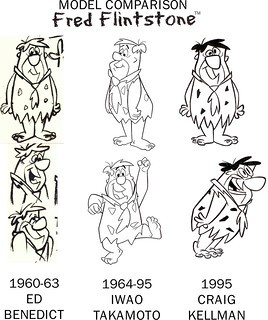
 Every famous cartoon character, from Mickey Mouse to Bugs Bunny, has been redesigned and reimagined many times over the decades, and the classic characters of Hanna-Barbera are no exception. However, few have had as radical and large-scale redesign as their characters went through in the mid-90s. And for that, you can thank Craig Kellman.


Craig Kellman's name might not sound familiar, but his portfolio definitely does. He's been an industry veteran since the 90's, having worked for everyone from Disney to Dreamworks. In the middle of that decade, he began working for Hanna-Barbera, joining the likes of everyone from Genndy Tartakovsky to Craig McCracken. To Kellman, the experience was something akin to a dream come true, as he was a big fan of the studio and its characters. To be more specific, he was a big fan of how the characters originally looked.


Like any character in animation, the designs of Fred, Yogi, and the rest weren't set in stone when they were first created. The initial designs were a bit blocker, but over time, the characters became more and more homogenized. In some ways, they lost their uniqueness, in an effort to have them conform to one particular style. Kellman wanted to bring back a sense of individuality to the characters, and Fred Seibert, who ran HB at the time, was happy to give him the chance to do just that. He gave him the order to redraw everything for The Flintstones, and Kellman was off!

These redesigns first started to appear in 1995, in conjunction with The Flintstones' 35th anniversary. They were featured heavily on merchandise from around that time, from picture books to Taco Bell tie-ins, and pretty much everything in between! Look below for a small sample of the redesigns as featured in the 35th-anniversary merch.


However, it wasn't the 35th anniversary that most people associate these redesigns with. No, when the topic of Kellman's interpretation of The Flintstones comes up, most think of the 2001 Cartoon Network special, Flintstones: On The Rocks. A TV movie that aired only once, this special was done by much of the Dexter's Laboratory team. Chris Savino, the main driving force behind the project, really liked Kellman's take on the characters and elected to use them here. 


Many believe the designs were created for this special and were never seen again, but just as they had been used in merchandise years earlier, Kellman's Flintstones designs continued to pop up in media over the following years. In fact, the designs are still used to this day! While most modern products tend to use the classic looks, it isn't uncommon to see T-shirts or Flintstones Vitamin packages featuring these versions of the character. Here's a T-shirt you can buy right now on Amazon as proof of that. While they aren't as recognizable as the classic counterparts, I must say that it's really cool that Kellman's take on the stone-age family continues to be used in merchandise, nearly thirty years after their inception.


Now, I did say this was a look at Craig's Hanna-Barbera redesigns, not just his Flintstones ones. While they weren't as heavily used, Kellman also redesigned essentially all of the other classic Hanna-Barbera characters, including Yogi Bear, Top Cat, The Jetsons, and Huckleberry Hound, just to name a few. These were most notably used in a series of bumpers that played on Cartoon Network towards the end of the 90's. Check out the complete collection below!


So, whatever happened to these redesigns? Why did we rarely see anything featuring them? Quite frankly, I think the answer is simple. Characters like Top Cat and Quick Draw McGraw don't have the same value in the public eye as The Flintstones do, so on the rare chances we do get media and merchandise with those characters, it makes sense they would use the classic interpretations that most are familiar with. For what it's worth, the same team that did the On The Rocks TV special storyboarded an entire special focusing on Quick Draw, which sadly got scrapped following the tepid reaction to the former. Perhaps that would have featured Kellman's designs as well? Aside from that, however, the designs of the other HB characters seem to be little more than a footnote in their histories. But for those of us who are fans of these characters and especially their earlier days, these designs will forever hold a special place in our hearts. As far as I'm concerned, none of the later takes on the characters even come close to Kellman's work. They were the perfect blend of old and new, and it's a real shame we don't see more of them.


Friday, November 3, 2023

A Taste of What's to Come

 Hey guys! I'll be out of town this weekend, and due to this trip, I decided to push back my next planned post to Monday, so I have some more time to iron it out. But I didn't want to leave you guys hanging, so I wanted to give you a sneak peek at that upcoming post.


Check back here on Monday morning for an exploration of Craig Kellman's redesigns of the Hanna-Barbera classics! I'll look at how the designs came into being, where they were featured, and whatever happened to them. I personally am a big fan of these retools, and I'm sure at least a few of you like them too, so I hope you're excited for this one!

Thursday, November 2, 2023

Hanna and Barbera: Conversations

 It's not every day we hear of a new book diving into the world of Hanna-Barbera, but luckily enough for us, this is one of those days.


Above is the cover art for Hanna and Barbera: Conversations, coming to us in May 2024 courtesy of the University Press of Missouri. This publisher has done many similar books about other artists throughout the entertainment industry, and Bill and Joe are the latest to get the spotlight. The book chronicles various stories about the duo and their career, told by both themselves and those who worked with them. You can take a look at the table of contents, which alone shows an impressive list of individuals: Iwao Takamoto, Ed Benedict, Fred Seibert, Scott Shaw, Yowp, and Don Messick are just a few of the fellows you'll get to hear from in this title. The book chronicles their careers, from their beginnings at MGM to the studio's pivot towards original programming for the Cartoon Network.

Preorders are currently available, both of the hardcover and paperback variety. I've already gotten my preorder set, and I urge any of you interested to do the same! More information on the title can be found on its page at the University Press of Missouri website. Pretty exciting stuff I must say!