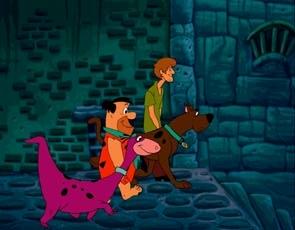
Typically, when you talk about something or somebody that is the last in a series, very rarely is anything good said of them. That is something that
be said about Mr. Fred Seibert. Though he was the last president to helm the Hanna-Barbera studio, he ushered in a level of innovation and creativity the place had not seen since its glory days in the sixties. He launched the careers of creators like Genndy Tartakovksy, revitalized the studio, and helped set Cartoon Network on its path to success. His knack for innovation and scouting talent continues to this day, and he remains a giant in the animation industry. A giant who just so happened to agree to an interview with me, the first I've ever done for his blog.
This past Wednesday, Seibert sat down with me to discuss his four years heading up Hanna-Barbera. We discuss the highs, the lows, and how it has shaped the rest of his career. I hope you enjoy this interview, and I hope for this to be the first of many in the future. Enjoy!
Noah Bell: What was your first experience with watching a Hanna-Barbera production? Can you recall that at all?
Fred Seibert: I remember it vividly. I was seven years old, and The Huckleberry Hound Show came on, and I had watched all the kinds of cartoons that were on TV in my era, but that was mainly retreads of all the great shorts from theatrical (Tom and Jerry, Looney Tunes, Disney). There was one I didn't know at the time that was made for TV, which is Crusader Rabbit. When The Huckleberry Hound Show came on, it was like the biggest show you could imagine. It was like when the Beatles came to America. I watched it religiously every day. I thought it was the greatest thing ever, and I followed all of the Hanna-Barbera cartoons that followed afterward: Magilla Gorilla, Quick Draw McGraw, Yogi got his own show. Then, when I was nine, The Flintstones hit prime time, and I died and went to heaven. I thought it was the greatest ever, and it had a lot to do with my eventually going to work there.
NB: I imagine! And out of all the Hanna-Barbera characters and shows, which ones hold the most special place in your heart?
FS: It was always Huckleberry Hound or The Flintstones. Those were the cornerstones.
NB: Those are also the right answers!
FS: When I got older and I got to work at the studio, I was surprised at how much I didn't like the Huckleberry Hound cartoons as an adult. They were a little weak, but at the time they were the greatest things ever!
NB: Jumping forward about thirty years or so, you're finally approached to take over Hanna-Barbera by Scott Stassos. At the time, they were running on fumes I would say.
FS: That's an understatement!
NB: It would definitely be an understatement! In the eighties, all they really had in terms of a hit was The Smurfs, and everything else was just going back to the same old well of characters, and I would say they were getting diminishing returns.
FS: Another understatement. When I got to the studio, they had a show called Yo Yogi!, which was Yogi at the mall with all the other teenage versions of the Hanna-Barbera characters. It was really sad.
NB: That was kind of the "in" thing at the time, to take the characters and make them younger. There was also The Flintstones Kids and Tom and Jerry Kids. It was either that or just making shows based on existing properties, like The Gary Coleman Show, and there was a GoBots cartoon they did. So when you came into the studio, there was a huge shift from that work to what you did with What a Cartoon!, Dexter's Laboratory, and The Powerpuff Girls. What did you think were the main problems plaguing Hanna-Barbera throughout the eighties, and what did you do to alleviate those issues?
FS: First of all, we start with the fact that Bill and Joe were geniuses. Not only their run of however many Tom and Jerry's they made which were some of the greatest comedy films ever made, certainly in combination of Bill's directing and production brilliance with Joe's character brilliance. When they came together for Hanna-Barbera they realized that the studios were abandoning theatrical cartoons for a lot of good reasons. That in order to make stuff for television, they had to find a way to take the basic rules of animation and make them viable for television, mainly budgetary. They had an incredible headstart. Not only were they brilliant, but all of their brilliant friends at all of the studios in Los Angeles were out of work. They could tap into these people to be part of their teams, so they had an infinite amount of brilliance that they brought to the table, and they figured every which way to skin the cat as it were, not to make a bad Tom and Jerry pun. Every which way you could think about cartoons over a twenty-year period, they had thought about. They executed on it, and they often executed very, very well on it: action-adventure, superheroes, traditional comedy, family comedy, they did it all. Some of it was great, a lot of it was very good, some of it was good, and then there were a few stinkers along the way of course.
When the eighties came around, the thing that had really changed was their business model of coming up with the ideas that they had and selling them to syndication had fallen off, and they were dealing more and more with the networks. At that point, those were CBS, ABC, and NBC. Those networks had a limited amount of time dedicated to kids' shows and ultimately, you were dealing with three executives at a time: the people in charge of kids at each of those places. And so, Hanna-Barbera had gone from an infinite view of what was possible, and had been squeezed down by the networks. Instead of their brilliance, it was the network executives who wanted to think that they were the brilliant ones! They had a lot of pressure from those network executives because no one at the networks gave a crap about kids one way or the other. In certain ways, they were forced to do it because, for one, the network's vision of themselves is we do something for everybody, and then the other thing is that there was a small group of advertisers who were interested in reaching kids. So, the combination of ratings pressure and advertiser pressure pushed Hanna-Barbera more and more into a small group. There were other independent animation companies around LA, but for a variety of reasons, mainly business, Hanna-Barbera became the company that the networks trusted the most. They were always able to deliver on time and on budget. Hanna-Barbera became a reliable source, but a narrower and narrower source, because now, since the networks didn't promote the shows, the shows had to promote themselves. The result was that more and more what the networks were requesting was not original ideas, but ideas that on some level were presold.
NB: Right, play it safe. Play the hits, is how you could also put it.
FS: Yup! So more and more, Hanna-Barbera was pushed into a corner where they were either doing things based on toys, which essentially became half-hour commercials, or they were based on movies that they wanted to turn into TV, or hit TV shows that they wanted to do animated versions of. At that point, Bill and Joe were in their seventies, their key staff was also in their seventies. When I got to Hanna-Barbera in 1992, there were literally people who had worked with them at MGM who were still working at the studio. They still had the energy to do the work, but I think in a lot of ways they were mentally wiped. They could rely on their own instincts less and less, and were being told what to do, and now they just had to execute other people's ideas. I think in many ways that was the end of their era. They were tired, more mentally than anything else.
NB: Then, as the eighties progressed, there started to be more TV animation beyond Hanna-Barbera. You had Disney starting to make original animation, WB got back into animation.
FS: Yeah, but that was really more towards the end of the eighties. In the aftermath of The Simpsons, the studios started waking up and going "Oh right, animation! Maybe we should do more of that animation stuff!" What Disney and Warners both did is they raided the top talent out of Hanna-Barbera because Hanna-Barbera employed more talent than anyone else, both executive talent and creative talent. They raided them, and the people at Hanna-Barbera kinda felt left out.
NB: Right. I bring up the influx of new animation in regards to Hanna-Barbera in the late eighties because, by that point, they had lost the monopoly on television animation. When you come there, no longer is Hanna-Barbera the face of TV animation. They were practically lagging behind everyone else. How did you work to get them back on the same level as their competitors?
FS: Well, I was really lucky. Hanna-Barbera had a new owner and he was a genius, which is Ted Turner. Ted Turner was the guy who was the first person to put a local television station up on a satellite, and turn it into a national station, which was the PBS superstation. He invented CNN, and had really dominated the world in terms of news journalism and TV journalism. He had bought the MGM studio which almost put him out of business, but it gave him a whole new library that allowed him to start the TNT network.
NB: And that included the MGM cartoons.
FS: Yes. What he got in that purchase is he got obviously all of the MGM cartoons, but also, at a certain point, MGM had bought all of the pre-1948 Warner Bros. cartoons. Then, on top of that, they had an arrangement for all of the Popeye cartoons. Now, Ted had a library of more or less 7,000 short cartoons, and as the cable universe of channels kept expanding, someone got the bright idea to start a cartoon network to compete with Nickelodeon. Nickelodeon had come out of nowhere, absolutely nowhere, and started dominating the kid business in a way that no one ever had. Ted saw an opening to compete, someone in the company said "Well, we have 7,000 cartoons we can start with", but then they realized that that wasn't enough. Coincidentally, Hanna-Barbera was on the selling block. The person who owned it, the CEO of Chiquita Banana, had bought them when Hanna-Barbera's parent company had blown up. His son wanted to be in show business, but by the early nineties, they realized it wasn't really going to work, and they started looking for somebody to buy it. They shopped it to everybody in the media business.
NB: And you actually suggested to Nickelodeon that they buy the studio, I believe.
FS: Yes, I absolutely did, and to not be too boring about it, there was a traditional way of valuing that kind of company that sat at the price of $175 million. No one in the business thought Hanna-Barbera was worth $175 million.
NB: They (the owners) wanted even more.
FS: The owner wanted $350 million. Ted was the only person, and his company, that imagined that they could have a cartoon network which would instantly revalue the whole library tremendously. Ted ended up with a financial partner and bought Hanna-Barbera for $350 million. He was the only one who came anywhere near the price that the owner was looking for. He got the library, and now they had to figure out what to do with the studio. There were a lot of people at Turner's company who wanted to take the library and close the studio, kind of like what they had done with MGM, but Ted was so excited about having a cartoon studio that he wouldn't let them close it, even though it was losing $10 million a year and they hadn't had a new hit since The Smurfs in 1981.
Scott Stasso was the president of Turner Entertainment (the division that was everything but CNN). He and I knew each other from back in the day, when he had run Ted's very short-lived video music competitor to MTV. He knew what I had done over at Nickelodeon, and got the stupid idea that I might be the right guy to run Hanna-Barbera. He called me up, I owned a branding company at the time, and he asked me if I wanted to come, and I said "Look, I watched cartoons when I was a kid. I don't know anything about making cartoons." Little by little, he persuaded me that I should at least think about it. My partner and I weren't getting along at the time and we were bored with what we were doing on the branding side of the business. After a few months, he persuaded me to go out to Hanna-Barbera, and in my head, I had two things in mind: I thought the idea of reviving all the classic characters was a great idea, and I had brought the Nickelodeon idea of how to make new cartoons. Not because I knew anything about making cartoons, but I had read this book that Leonard Maltin and Jerry Beck had done about the history of short cartoons (Of Mice and Magic). Honestly, it was really exciting, because I love cartoons, but it was really exciting because it also reminded me of the record business which, in my generation, was one of the most exciting parts of pop culture in the world. As I read this history of cartoons that Leonard and Jerry had put together, it felt a lot to me like the history of the music business that I had read. I said, "Oh, there's a chance to bring new talent into the cartoon business in the exact same way that the record business does: shorts." To me, short cartoons were the equivalent of hit singles in the record business. The reason the record business did it is it's cheaper to make a single than an album, and they could try out different groups and singers through singles, and if the single did well, they made an album. I said, "Why can't we do the exact same thing in television?" I brought that idea to Nickelodeon, they didn't really like the idea all that much, and it made me annoyed. Even though I didn't know anything about cartoons, I knew it was a good idea, and they weren't interested. When Hanna-Barbera came along and Scott asked me to do it, I had those two ideas in my head.
I got to Hanna-Barbera, I walked in pretty much the first time as the boss, which is the most ridiculous thing in the world. I had no idea what I was doing. I went to Scott Stasso and I told him I wanted to do this idea of these short cartoons. The way I described the business part of it, he said "Well, Ted won't be interested in that." My view of it was that, if someone came up with the idea for a short cartoon and we didn't make a series, that they be able to hold onto the rights. At the time, Ted's point of view was "If I pay for it, I own everything." So it didn't really work at that point. Then I started thinking closely about the idea of remaking things, and I saw some of the stuff that Hanna-Barbera had remade, and in my own mind, I started feeling like you can't go home again. It was hard enough to be great once, but trying to be great a second time at something is really tough. Honestly, because I was very focused on early Hanna-Barbera, I completely missed the Scooby-Doo revolution. I was never thinking about making new Scooby Doo's, I was only thinking about the older characters. It didn't really sit well with me, and I can't explain why. It just didn't seem like a good idea.

Since I wasn't able to do the shorts, I started looking for new series to do. We greenlit a couple of series, one was called 2 Stupid Dogs, the other one was SWAT Kats: The Radical Squadron. We made these two shows, and we distributed them through syndication, sort of like how Hanna-Barbera had started. It was pretty clear pretty fast that it wasn't going to work. The shows were good but they weren't great, and I was a little stuck. They cost a lot of money, probably $10 million between them, and that was my entire budget. When I started thinking about the business part of the shorts, I realized that they would cost $10 million. Now, I had to go to Ted and say "I want to do this idea that you don't really want to do. My budget is zero, so I need an extra $10 million." I pitched him the idea, and he said "Well, you already made two and they failed. Why should we trust you to make more more?" More or less, I said, "Look, if we try something forty-eight times (the budget was for forty-eight cartoons), don't you think something will work?" Like I said, I was really lucky I worked for a genius entrepreneur, because that really hit Ted's sweet spot. Try new things, and if you try things enough, something will work. They gave us the budget, and we were off to the races!
NB: I'm glad you brought up What a Cartoon! because that, as an observer, seems like probably the biggest undertaking of your time at Hanna-Barbera. What was the production of a show like that compared to, say, a 2 Stupid Dogs cartoon?
FS: It was kind of a mess in certain ways because, under Bill Hanna, the studio had been structured in a very industrial manner to the degree that most of the creative staff were really unhappy. Bill, who thought like an engineer in many ways, was thinking of the most efficient way to do something. So the people who directed cartoons never talked to the people who created those cartoons. After the scripts were written and the boards were done, they were handed to the directors, and then the original people weren't allowed to talk to the directors, and the directors got to do what they wanted to do.
NB: There was no communication between either.
FS: Right. When we did 2 Stupid Dogs and SWAT Kats, I rejiggered the studio so that there was a clear line, and everybody in the production was in it together. That just confused the studio. They were kind of annoyed at me actually, some of them were angry, and many people quit on me. Then, when I said we were going to do forty-eight cartoons like that, where there were forty-eight creators and each of those creators had sway over how their cartoon was made, oh my god, it was like a nightmare! On top of that, in most studios, there is a department called the development department, which decides what gets made and how it gets made. When talking to Bill and Joe and Fritz Freleng and the young guy in the world that was making cartoons at that time, John Kricfalusi, I talked with all of them. I asked Bill and Joe "How did you produce your Tom and Jerry cartoons", and what they said was "Well, we would make one cartoon, and the studio would put it in theaters and if people liked it we got to make another one." I said, "And what did the studio tell you to do", and they said "Oh, they just left us alone. We went to the studio, and we did what we did." That made a lot of sense to me, so my view was if a creator pitched us a cartoon, we were going to pitch it completely differently. It wasn't someone coming in and saying "Here's my idea for a cartoon: it's a young boy who's a mad genius, he has a lab in his room, and his older sister's always bothering him. Do you wanna make my cartoon?" Instead, I said, "You need to pitch us an entire storyboard of the short that you want to make." Not a production storyboard, but what we call a beat board, which is the entire story and the dialogue with rough drawings. I wanna know exactly what film you want to make, not what the idea is, because the distance between an idea and the execution is lightyears.
NB: It's night and day.
FS: Like, your way of executing a cartoon about a boy genius and my way of executing it and Genndy's way, that's three different ways of taking the exact same idea and doing something with it. I wanted to know, if we were going to spend what ended up being a couple hundred thousand dollars on cartoons, exactly what we were gonna make. Right from the beginning, the way we even said yes to things was completely contrary to the way the studios usually made things. One by one, the people in my development department quit or I had to fire them and bring in new people.

Once we started greenlighting shorts, another problem arose. The creator would start the cartoon, and the development person would come in and tell them how they could do it better. People would get really mad, and I didn't really know what was going on. Finally, someone told me "I thought you were gonna let us do our short that we pitched." I said, "Yeah, absolutely!" They then went, "Then why is this person telling me to do something different?" The first thing I had to do was move all those people out of the way, and then the next problem came in because of the production system. Another person came in and said "They aren't directing the cartoon the way I want it directed. They're doing what they wanted to do." Now, I had to sit down with the directors and explain that their job wasn't to make it look like every other Hanna-Barbera cartoon, but their job was to listen to the creator, whom we had picked very carefully. Remember, we probably saw 5,000 pitches for the forty-eight shorts that we made.
NB: And it was all over the world too, right?
FS: All over the world, and some veterans, and a lot of newbie talent. There was a lot of talent from the 2 Stupid Dogs team. Almost everyone on that team was stunningly talented. On top of that, I was really biased towards artists who created their own cartoons, rather than a writer who wrote a script for a cartoon, and then got an artist to execute it. I made sure that if there was a writer involved, their partner was an artist from the very beginning, and they had to create it together. All of these things were contrary to the way the studio was used to doing business, and each production needed to be set up from scratch, and then twelve weeks later, it disappeared. It was this constant churn and the studio just wasn't ready for that at the time. It was tough.
NB: I can imagine! But, through What a Cartoon!, there were so many of Cartoon Network's earliest hits that came out of it: Dexter's Laboratory, Powerpuff Girls, Johnny Bravo. For a lot of people around my age, we look at those characters in the same way as The Flintstones or Scooby-Doo, or a lot of the Hanna-Barbera classics. For you personally, how does it feel to have shaped not just so many classic cartoon characters, but also the careers of people like Craig McCracken?
FS: I'm awed and honored. I'm awed because we actually pulled it off, shockingly. It worked even better than I expected it to work! I'm honored because these great people put their careers in our hands and we were able to repopulate the business with a whole new generation of great talent through today. They are now the veterans of the business!
NB: Absolutely! We've talked a little about the new wave of characters, but Hanna-Barbera of course continued to do things with the classic stable of characters. There were still Flintstones specials, and there were still Yogi Bear cartoons. What was it like producing new installments for those series which, kind of like the studio in the eighties, were also running on fumes? At that point, the characters were kind of just going through the motions.
FS: When I was first there, we did a series of one-off specials that were based on Scooby and Flintstones, and they were sort of churned through the system the way it had always worked. Frankly, I paid no attention to them, because I just knew that what they were, in the modern language, was "content". If there's anything I hate in life, it's "content".
NB: That makes two of us.
FS: It was just product, like they were cranking it out. Then, we did a couple things, some of which started with me, and then I left the studio before they were fulfilled. There was a young character designer who, again, has since become a great veteran named Craig Kellman. He was very excited about the way the characters were originally designed. Over the years, Hanna-Barbera had changed all of the original designs and tried to make them very uniform. The characters are all designed in a uniform way so that Magilla Gorilla and Fred Flintstone could exist alongside each other.
NB: They kind of all lost their uniqueness.
FS: Yeah, and Craig was interested in the original designs, and he was a young guy, so he was a contemporary artist also. I gave him the assignment on The Flintstones in particular to redraw everything.
NB: And he continued to do that with the other characters, right?
FS: Right, but he really did it with the Flintstones. He did some other stuff too, but that was the big thing. In fact, after I left, Brian Miller and his production team over at Cartoon Network Studios did a special based on all those designs. It wasn't great, but it was pretty cool, it at least looked good! We also made a deal with John Kricfalusi to do some Yogi Bear's for Cartoon Network. Again, they were started when I was there, but I left when Ted sold the company to Warner, and I wasn't interested in working for Warner. But Mike Lazzo, who was the head programmer of Cartoon Network and eventually invented Adult Swim, looked over all of those and they did some great stuff. I was thrilled that it happened but honestly, I was looking at that as in the past. At that point, I was more excited about the new stuff we were doing which was, in my view, in the tradition.
NB: Going from that, if you had a crowning achievement of your time at Hanna-Barbera in those four years, what would you say it was? Was it the What a Cartoon! series?
FS: Completely. Remember, I had some disasters, too. The reboot of Jonny Quest almost tanked my entire career.
NB: I actually wanted to bring that up! I was going to ask what your worst decision was, and I imagined it had to do with Jonny Quest.
FS: It was a horror. I did everything wrong! The biggest thing that I did wrong is, I never had a natural feeling toward action-adventure cartoons. It wasn't my field, so I did Jonny Quest for business reasons which, for me anyway, is the worst reason to do something. You know when you're playing football and somebody tosses the ball to you and you fumble it, and you try to get yourself straight but can never get yourself out of the fumble? That was the entire production for me. It was one fumble after another, and when I realized the mistakes I made, I made more mistakes. It was just horrible.
All in all, What a Cartoon! not only set the stage for the future of what became Cartoon Network Studios and Cartoon Network and the industry, but it became my future, too. Afterward, I made another 200 shorts on my own after Hanna-Barbera, so it was sort of the fuel of the rest of my cartoon career.
NB: And you've kept that going. You've helped launch the careers of other new creators. Pendelton Ward is certainly one, and you've just kept on going!
FS: Exactly. What a Cartoon! was exciting by itself, but what was even more exciting, is that, if you look at those cartoons, is that generation, like me, missed the classic cartoons and they missed the opportunity to be involved in the classic cartoons. In many ways, What a Cartoon! was sort of a reboot of that tradition. By the time I started doing Oh Yeah! Cartoons and then eventually Random! Cartoons, that generation of creators had moved past that. They were taking what they had learned from watching those classic cartoons, from watching the What a Cartoons, and they were now moving into a new way of thinking about things. I use a lot of parallels to popular music, so I think of What a Cartoon! as the Big Bang. They're like the Beatles. Pendelton Ward is more like the alternative-rock bands, like R.E.M. and U2. They're taking the things they understood about classic cartoons, and putting their own contemporary spin on them. You now have a whole different approach to thinking about characters, to thinking about comedy, to thinking about story. On every level, they represent a new generation of creative thinking.
NB: We're now at thirty-plus years since you took over Hanna-Barbera. How do you reflect on your time there? Were there things you think you could've done better?
FS: Well sure, because I did a lot of things badly! But I look at it ultimately as a great success both personally and professionally. Nickelodeon really had lit the fuse for the future of kid's cartoons. They started with Ren and Stimpy, Rugrats, and Doug. But I feel like what we did with Hanna-Barbera is we took what they did and industrialized the whole business. It wasn't just a few individuals here and there, now we set a template for the entire industry. When I look back on that period of time and I see what people have done — until now, as things have changed again — for thirty years, everybody was working off of a very similar model. When we started, and I would say "I want to work with artists who write their own stuff", the common refrain across the industry was, "Well, you know, artists can't write." I'd go "As far as I can tell, most writers can't write, either. They just know how to type." It doesn't mean that every artist knows how to write, but that the artist can really know how to create characters and stories.
NB: At the end of the day, both are still telling a story.
FS: Right, and by the way, the artists' ideas have been ignored for twenty or thirty years! Once The Flintstones came in, instead of artists creating the Hanna-Barbera cartoons, Joe hired scriptwriters for the very first time because of the volume that Hanna-Barbera was going through. They couldn't find enough artists who could create, so they started bringing in scriptwriters. By the time I got into the business, that was the standard. We started on a different premise. I got this from John Kricfalusi more than anyone else, he was the one who said to me, "Pay attention to the artists. They're the unique part of making a cartoon. Why wouldn't you think about them?" Then, for the next twenty or thirty years, an enormous amount of the cartoons were made by the artists. That was a big difference.
So I feel good! When I look back on it, it was an unbelievable personal experience for me. It changed my work life. At that point, I hadn't done anything for thirty years. I hadn't even done stuff for ten years! It changed my life, but I also think it changed the industry for good.
NB: I imagine you must feel pretty proud of that.
FS: I really do! And like I said, I'm honored that those creative people were willing to jump into the abyss with me.
NB: To top it all off, what's next for Fred Seibert?
FS: As you know, I had Frederator Studios for twenty-some-odd years, and I left there last year. Then, I started a new company, FredFilms, which makes cartoons. The current marketplace is not a friendly one for original ideas, but we'll keep making them, and one day, somebody will say yes. At the studio, we have three promises: creators first, original always, and the third one, which encapsulates all that and more, is we hope we're going to make your next favorite cartoon. Hopefully, one of the shows we're developing will be everybody's next favorite cartoon!

If you'd like to learn more about Seibert's time at Hanna-Barbera, I recommend checking out his blog on Tumblr, but primarily his series of Hanna-Barbera essays. I've recommended this blog before, and will likely continue to do so in the future. It's not every day we get to hear from the president of an iconic animation studio, but Seibert has no issue sharing stories about his time at the company, so I implore you to give the blog a look!